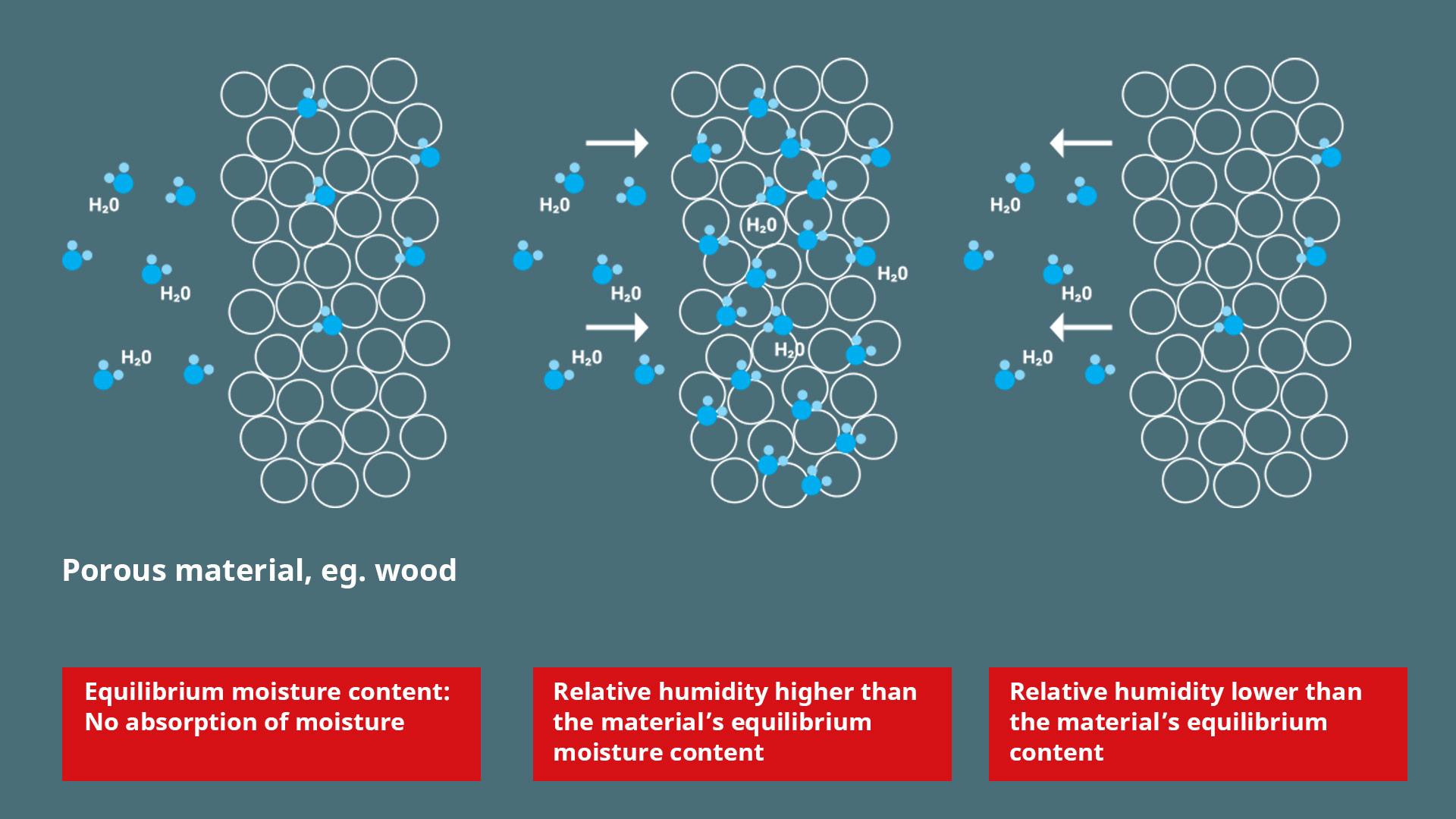
Wood straight off the sawmill can have a water content of up to 30%; if the relative air humidity is too low, the wood will immediately begin to lose moisture. In fact, wood acts like a sponge – and will release its moisture to the air in case of low air humidity.
The correct amount of moisture increases the wood’s ability to withstand mechanical forces. Well-seasoned wood has reached an equilibrium point in which the wood’s natural hygroscopic affinities are kept in check, allowing the wood to keep its shape – in fact, construction wood that is kept under climatic control has a life span measured in centuries.
Furthermore, seasoned wood is much less vulnerable to degradation due to fungus or insects – in other words, it has become biologically stable. This is why seasoning of wood is a vital process in any industry based on wood – furniture, instrument making, construction etc.
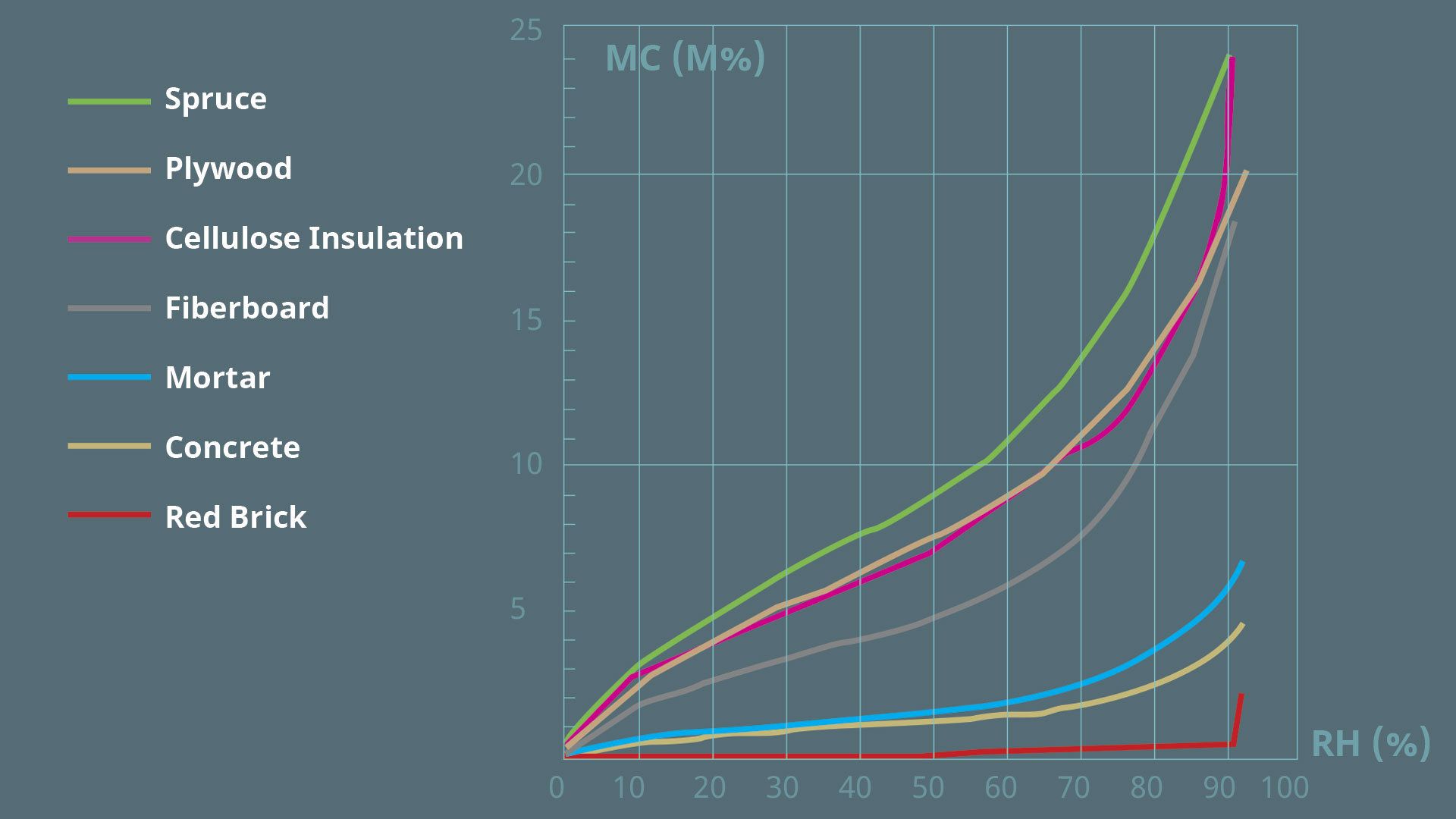
When wood is exposed to a constant relative humidity (RH), it will eventually reach its equilibrium moisture content (EMC). The wood will stay at this humidity level as long as temperature and relative air humidity stay constant.
As an example, the moisture content of plywood at 25° C is:
6% EMC at 40% RH
10% EMC at 70% RH
28% EMC at 100% RH
This is one of the many reasons why the wood industry often air humidifying systems: To maintain a relative air humidity consistent with the correct seasoning and storage of wood products. If the relative humidity is too low, the wood will not season, but will dry out.
The results can be a complete write-off of the product: Warping, cracking and uncontrollable dimensions can lead to any wood product becoming worthless. In the wood working industry, maintaining the right air humidity is quite simply a question of ensuring the highest levels of productivity and of keeping product waste to a minimum.
The moisture content of a piece of wood is the total amount of water (or moisture) contained in that piece of wood. Moisture content is measured as the difference between the mass of wood with moisture “m” and without moisture “mod” (oven-dry mass), divided by the mass of wood without moisture “mod”:
Moisture content = (m – mod)/mod
Moisture in wood is either free water (water in cavities in the wood) or bound water (intercellular water). When no free water is left, the wood is said to have reached its fiber saturation point.
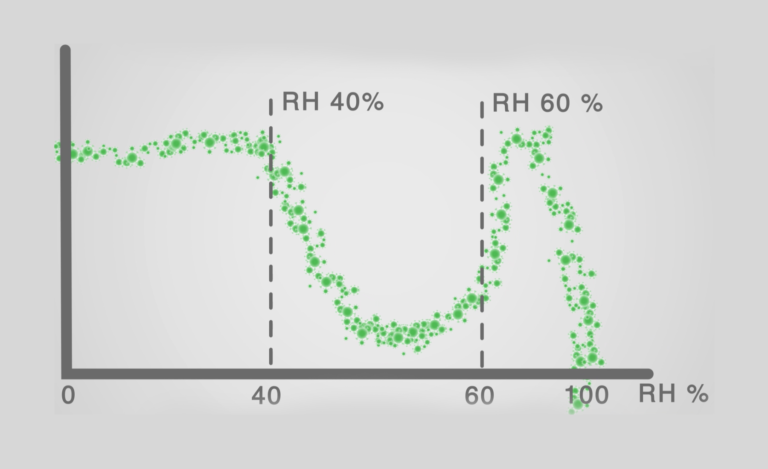
The optimum relative air humidity in wood production is typically 50 – 60% and must be kept within these limits throughout the year.