Virus and air humidity #03
A well-regulated indoor climate can help contain the spread of airborne virus. In this blog post, Airtec® sums up the facts and the recommendations.
A well-regulated indoor climate can help contain the spread of airborne virus. In this blog post, Airtec® sums up the facts and the recommendations.

Scientific studies strongly indicatethat a well-regulated indoor climate has an impact on the spread of virus and on our immune response to virus. In this final blog post about virus spread and air humidity, we want to sum up the knowledge and the recommendations that currently exist – from both the WHO and ASHRAE –the American Society of Heating, Refrigeration and Air-conditioning Engineers.
All these are just indications, not final results – the WHO has until recently maintained that flu virus is not transmitted via air, but they still recommend social distancing just to be on the safe side. In recent messages from the WHO, the organization has stated:
“WHO continues to recommend airborne precautions for circumstances and settings in which aerosol generating procedures and support treatment are performed, according to risk assessment.”
In other words, to implement measures that contain the airborne spread of virus *1.
Most infections occur through direct physical contact or when – simply put – someone sneezes in your face. This is one reason why social distancing is advised during a flu epidemic. But if virus stays infective for minutes or even hours while airborne, social distancing is advised even further.
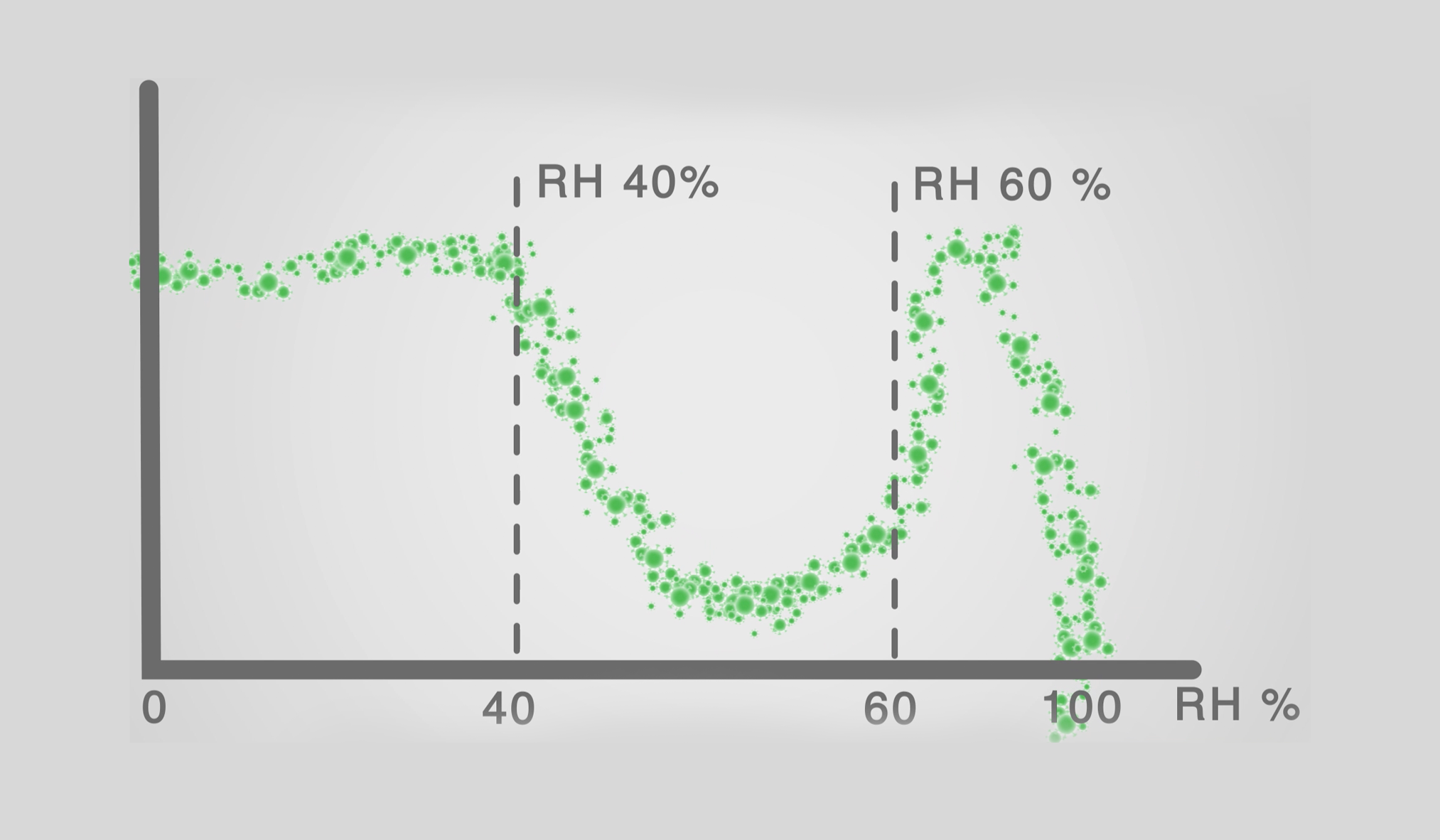
And this is also why we recommend keeping indoor air humidity at a certain level: Airborne virus has much lower chances of success when indoor air humidity is kept between 40 and 60 % relative – which is, incidentally, also the range in which we as humans feel most comfortable.
This may seem counter-intuitive, as a “wet” environment would seem to benefit virus. But several studies have shown this to be a false presumption, including studies from 2014 from the Journal of Virology, stating: *2
“Influenza virus was consistently found to be stable at low RH and relatively unstable at intermediate RH (e.g., 50% RH)”
It is important for Airtec® to stress three things in this respect:

In the USA, researchers and scientists connected to ASHRAE have urged builders and building owners to consider the effects of ventilation and humidity control as a way to create an indoor environment that is less conducive to the spread of virus due to aerosol transport. *3
Specifically, the ASHRAE has issued a report in which they urge designers of indoor climate control systems to consider air humidity control as well, all based on the arguments we have used in this series of blog posts.
But, crucially, ASHRAE also concludes that it is impossible to say beforehand what level of air humidity is right for which building. It must always be based on a site assessment in each individual case, and it should be based on rigorous engineering standards and best practice.
This is also what we strive to do at Airtec®. We follow a pragmatic approach to the design and installation of air humidification systems – the same approach that ASHRAE advocates. Backed up by science and research, we want to create air humidification solutions that solve the issues that are relevant, in a healthy, viable and technically sound way, using the on-site data and the specific requirements for one particular installation.
We begin most projects with a review of the facilities – a Site Assessment, where we visit a production facility or commercial building. We collect on-site data on the building layout, location of machines and heat sources, as well as the challenges that apply to on-site production.
We also look at existing ventilation and air extraction systems. Based on that knowledge we give our recommendations on whether an air humidification system would be a good idea – and if so, how this system should be designed, installed and serviced.
Designers, engineers and owners of commercial buildings and production facilities already have a good understanding of the benefits of air humidification systems in terms of creating a productive environment.
In the future, it is our hope and belief that we all will begin to think in terms of limiting virus spread as well, when we design or refurbish our homes, offices, schools, public institutions and offices.